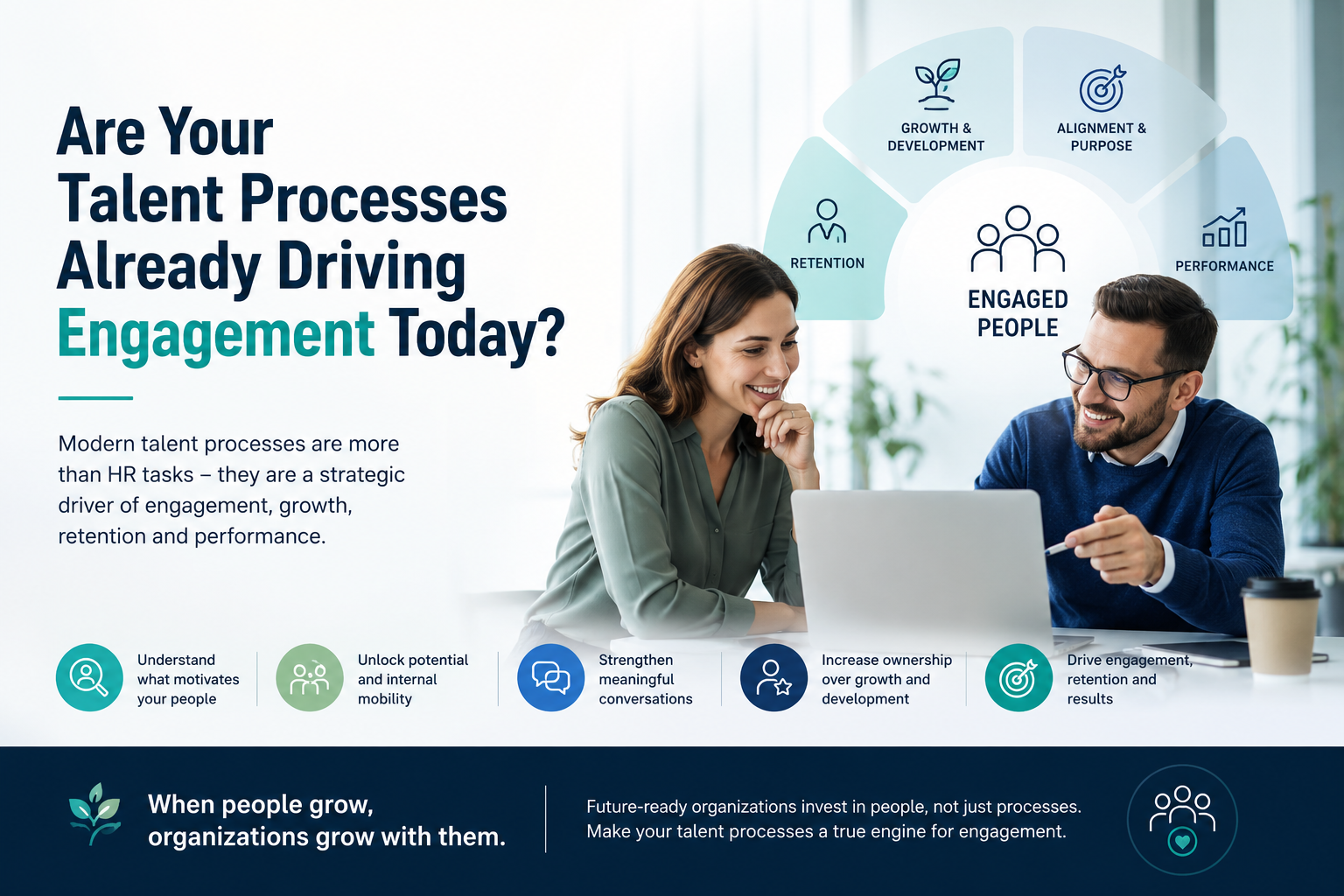
Many organizations still treat talent processes as administrative HR tasks. But in today’s rapidly evolving workplace, they are becoming a strategic lever for engagement, retention, and sustainable growth. Organizations that truly invest in understanding people’s motivations, strengths, and development potential create stronger connections between employees and business goals.

ARE YOUR TALENT PROCESSES ALREADY DRIVING ENGAGEMENT TODAY?
The organizations that will thrive tomorrow are those that understand, develop, and activate talent today. Modern talent processes are no longer just HR formalities — they are strategic drivers of employee engagement, internal growth, retention, and long-term performance.
In many organizations, talent processes are still viewed as administrative HR activities.
But in today’s rapidly changing labor market, they have become a crucial lever for engagement, retention, growth, and performance.
Organizations that succeed in creating sustainable impact are those that connect talent management with people’s aspirations, strengths, motivation, and development potential. Instead of focusing solely on performance metrics or job descriptions, leading companies are building environments where employees feel understood, valued, and empowered to grow.
Research increasingly shows that employee engagement is strongly linked to the overall employee experience and the quality of talent conversations inside organizations.
Too often, performance reviews, career discussions, and development plans become formal exercises with little real impact. Employees experience them as disconnected from their ambitions and day-to-day reality.
Modern talent processes should instead help organizations to:
When talent processes are approached this way, they become a catalyst for engagement rather than an obligation.
Forward-thinking organizations are increasingly investing in data-driven talent intelligence to support better people decisions. The focus is shifting from reactive HR processes to proactive and personalized talent development strategies.
This evolution is not about replacing human judgment with technology.
It is about equipping managers, HR professionals, and employees with deeper insights that lead to more meaningful dialogue and smarter development actions.
Organizations that successfully embed talent intelligence into their people strategy often see improvements in:
Employees want more than a salary or a job title.
They want to feel connected to meaningful work, recognized for their strengths, and supported in their future ambitions.
That means organizations must evolve from standardized talent processes toward more personalized and human-centered approaches.
Strong engagement is rarely created through isolated initiatives or perks. It grows when people experience:
The organizations that will thrive in the future are not necessarily those with the most talent — but those that are best at understanding, developing, and activating it.
Talent processes should therefore not be seen as HR administration.
They should become strategic drivers of:
Because when people grow, organizations grow with them.


